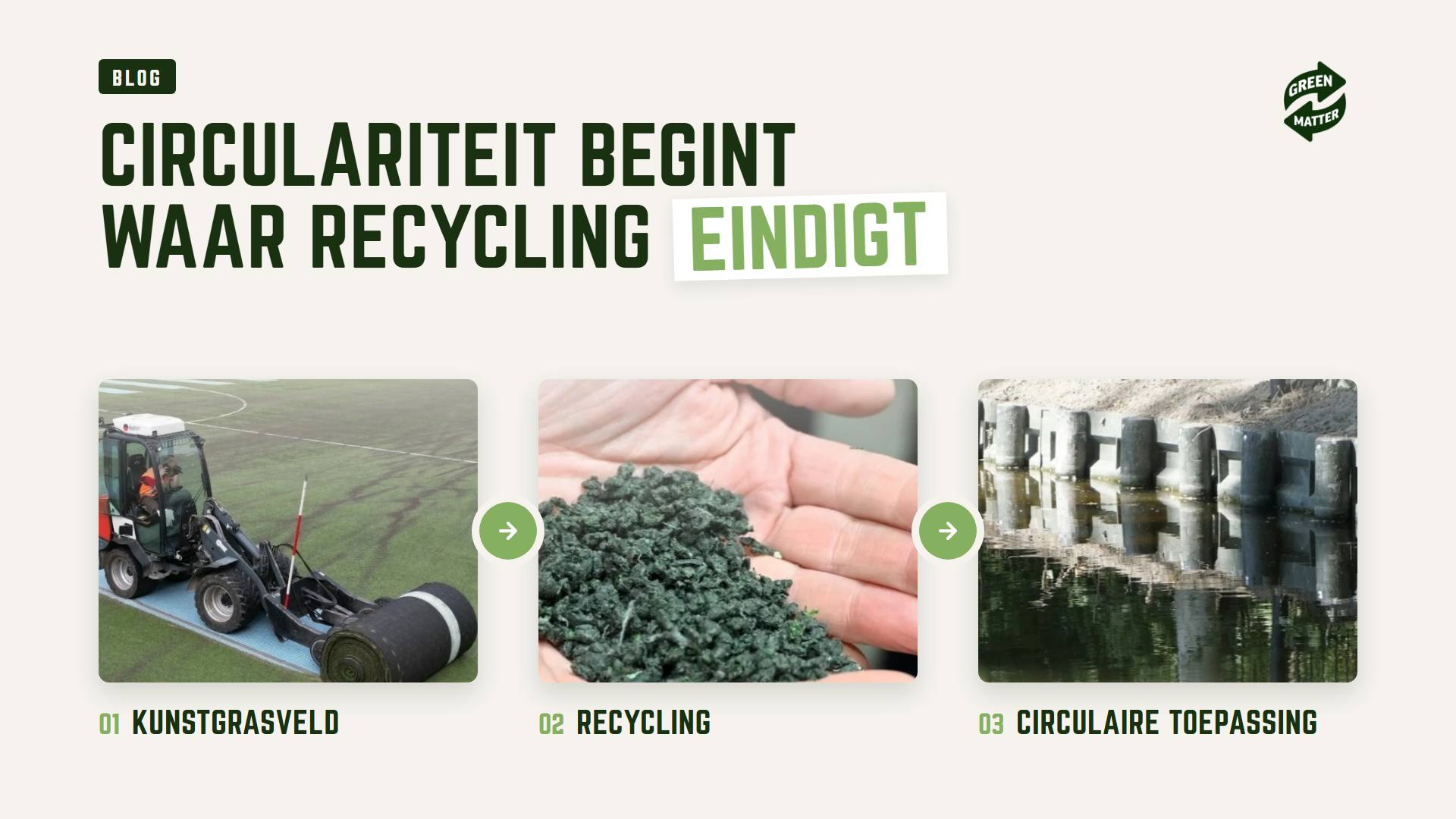
The next step in the circular processing of artificial turf: from recovered raw materials to new applications.
The circular processing of artificial turf requires more than simply recycling worn-out sports pitches. In recent years, significant progress has been made in recovering valuable raw materials. While this progress is essential, the next step deserves just as much attention: actually using these materials in new, high-quality products.
This is a shared responsibility for recyclers, manufacturers, municipalities, sports clubs, contractors and suppliers. After all, without buyers, the value of recycled materials remains untapped.
At GreenMatter, we have been working to bridge the gap between recycling and new applications since 2018. In doing so, worn-out artificial turf gains a new purpose in products for sports, play, public spaces and infrastructure.
When considering the future of artificial turf, we often focus on new materials and the recyclability of future sports pitches. At the same time, the artificial turf already installed at our sports facilities requires a responsible destination.
An artificial turf pitch typically has a lifespan of approximately 10 to 12 years. As a result, pitches reach the end of their service life every year that were installed at a time when end-of-life processing received less attention than it does today.
When these pitches are replaced, responsible collection and processing are essential. Depending on their quality, artificial turf fibres and other materials can be reused. A pitch that is no longer suitable for sporting activities therefore still contains valuable raw materials.
This is not only relevant to existing sports pitches. By incorporating secondary raw materials into new products, we also reduce the demand for primary raw materials. Their extraction and production have an environmental impact. Furthermore, international markets and geopolitical developments can affect prices and availability. Keeping existing materials in use for longer helps reduce this dependency.
Artificial turf recycling has continued to evolve. By carefully separating and processing worn-out artificial turf pitches, materials can be recovered and reused as secondary raw materials.
However, recycling alone does not make the supply chain circular.
To achieve this, recovered materials must actually be incorporated into new products. Preferably, these should be long-lasting applications in which maintenance, reuse and recyclability are considered from the design stage onwards.
High-quality recycling is therefore not just about the volume of material processed. Preserving the quality of raw materials and ensuring they serve a valuable new purpose is equally important.
In practice, this is a challenging supply chain. Innovation and processing capacity require investment, while the market for recycled materials must develop simultaneously. If demand falls behind, stocks of recycled raw materials can accumulate, putting the continuity of recycling initiatives under pressure. This makes coordination between recyclers, manufacturers and buyers essential.
The supply of worn-out artificial turf is largely determined by the replacement cycles of existing pitches. However, demand for products incorporating recycled materials does not arise automatically.
New processing technologies and sufficient recycling capacity remain important. But to make effective use of recovered materials, the market must grow alongside them. This requires high-quality products that meet technical requirements and can fulfil their intended function for many years.
Manufacturers develop these products, and suppliers make them available. Clients increase demand by incorporating them into their projects. By connecting knowledge of available material streams with future procurement needs, supply and demand can be better aligned.
Without consistent demand for products containing recycled raw materials, a significant part of the circular supply chain remains untapped.
Circular ambitions only become tangible through the decisions made in individual projects. Technical requirements, budgets and existing agreements all play a role. As a result, circular alternatives are not always automatically considered.
At the same time, we are seeing clients take a broader view of the value of their decisions.
The initial purchase price is only one factor. A product containing recycled raw materials may be more expensive to purchase than a traditional alternative. However, installation, maintenance, service life and future replacement also determine the total cost. The extent of any cost advantage varies by product and application and becomes clear through a well-founded comparison of total costs.
Social and environmental value also matter. Reducing the use of primary raw materials helps limit environmental impact. Some applications also contribute to climate adaptation, biodiversity or efficient use of space. Assessing both life cycle costs and environmental performance provides clients with a more comprehensive picture.
Municipalities, in particular, can play an important role in increasing demand for circular products. They are often the owners of artificial turf pitches or responsible for commissioning them, while also procuring facilities for sports venues, public spaces and infrastructure.
They therefore influence both the materials released when pitches are replaced and the demand for products in which these raw materials gain a new purpose.
By allowing demonstrably high-quality circular alternatives in projects, technical specifications and tenders, municipalities can strengthen this demand. This can be achieved through transparent and appropriate criteria, without specifying a particular supplier or solution.
This represents the transition from waste management to strategic resource management: not only knowing where worn-out artificial turf goes, but also connecting it to new applications.
The possibilities for reusing recycled artificial turf are already visible in real-world projects. Together with our supply chain partners, we develop and implement these solutions.
In the bank protection project in Amsterdam-Noord, more than 2.2 kilometres of bank protection are being installed using recycled artificial turf, incorporating an amount of material equivalent to more than two football pitches. The municipality and the contractor involved created opportunities for a circular alternative. As a result, the recovered raw material gains a new purpose in infrastructure.
Recycled artificial turf also serves several functions at Onze Gezellen sports club in Haarlem. Commissioned by SRO Kennemerland, the project incorporates a modular sports surface, a calisthenics Monkeybar, a bicycle parking system, ECORASTER grids and diamond-top bollards, among other products. According to our project data, these applications collectively contain 7,157 kilograms of recycled artificial turf.
In addition, permeable car parks featuring ECORASTER grass grids combine circularity with climate adaptation. The grids contain recycled artificial turf and allow for water infiltration and vegetation. In this way, a single application can address multiple challenges within a sports facility or public space.
These examples demonstrate that a worn-out artificial turf pitch does not necessarily have to become another artificial turf pitch. Products for public spaces and infrastructure can also provide a valuable destination for recovered raw materials.
A functioning circular supply chain requires collaboration: from collection and processing to manufacturing and procurement. What matters is not only how much artificial turf is sent for recycling, but also how much recovered material is incorporated into new products.
The next life cycle also deserves attention. Will the products we manufacture today be maintainable, reusable or recyclable in the future? This question should already be considered when selecting materials and designing products.
The momentum is growing. More and more clients are creating opportunities for circular alternatives, while manufacturers are developing new applications. By connecting these initiatives, demand for secondary raw materials can continue to grow.
At GreenMatter, we are committed to contributing to this development through product innovation, collaboration and projects in which recycled artificial turf is put to use again.
Recycling turns worn-out artificial turf back into a raw material. Incorporating it into new products gives that material another life cycle.
Sharing knowledge and experience helps advance the development of new circular applications.
Are you a pioneer, ambassador or knowledge partner who shares our vision? Help spread this message. Share this article, start the conversation and inspire others to incorporate recycled raw materials into new applications.
Because the bigger the movement, the more we can achieve together.
In our whitepaper, ‘Artificial Turf Waste as a Circular Raw Material – The Key Role of Municipalities in Closing the Loop’, we demonstrate how municipalities can connect material streams with circular commissioning, procurement and new applications.
Download our whitepaper.
Recycle the present, save the future.